Overview
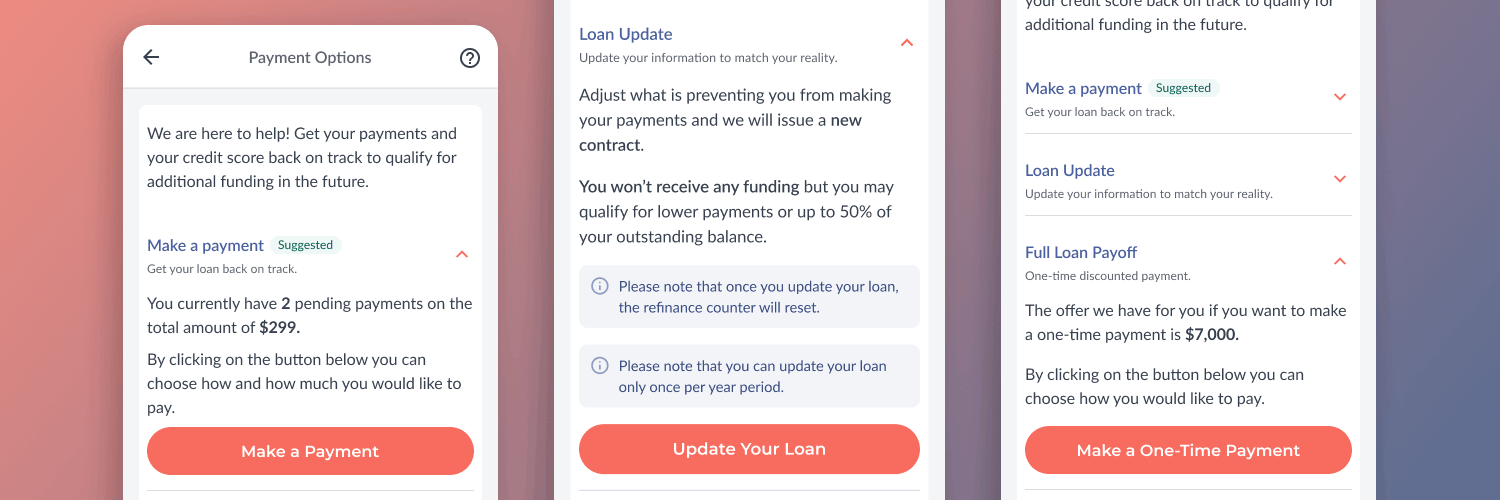
This project addressed a critical gap in how delinquent customers were guided to resolve their loans.
Although multiple resolution paths existed, the interface implicitly pushed customers toward a loan update or full payoff, assuming long-term financial distress, while not addressing customers with short-term financial hardships.
Discovery
When customers accessed their dashboard in a delinquent state, they were presented with three options:
- Lower their payment amount
- Update their employment information and lower the payment amount
- Pay the loan in full
Both options 1 and 2 triggered a Loan Update flow that liquidated the existing loan and generated a new loan with updated terms and discounts. This was not made clear to customers, leading many to believe they were simply making a payment.
Once the customer entered the Loan Update flow, they saw a very technical form-type interface that was an internal interface and didn’t have any resemblance to the onboarding flow.
Reviewing customer support logs revealed recurring issues:
- Customers unintentionally created new loans
- Users believed they were making partial payments
- Requests to revert loan configurations or cancel payments were common
“I didn’t want to create a new loan! Can you cancel it?”
“I thought I was making a payment!
Can you revert my loan to its previous configuration?”
“I need that money [used to pay in full the loan] back!
Can you cancel this payment?”
Premature full loan payoffs and unnecessary discounts also reduced business profitability.
Solution
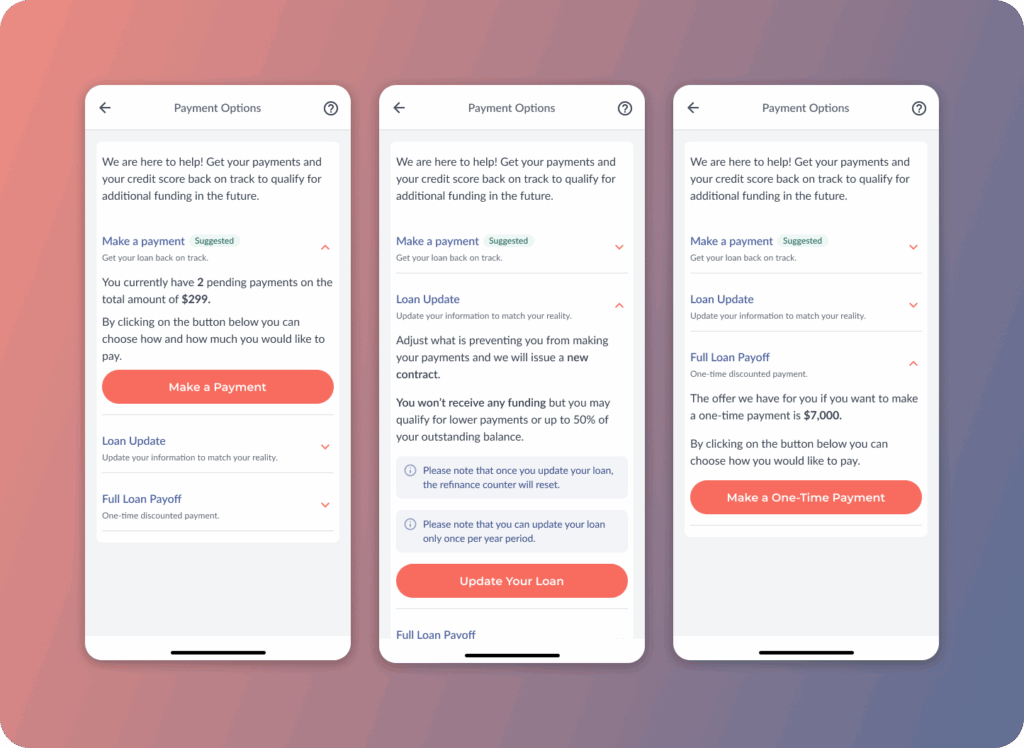
I proposed a redesigned delinquency flow that:
- Clearly separated becoming current, paying in full, and updating the loan
- Clearly stated what each option did and displayed exact payment amounts upfront when applicable
- Replaced the current flow with a loan update experience aligned with the onboarding flow, making it clear that the customer was entering a new loan process
Expected Impact
- Reduced customer confusion during delinquency
- Fewer support requests related to mistaken payments or loan creation
- Improved transparency and trust in a high-risk financial flow